
OPEN BADGESOpen Badges
What are Open Badges? Digital credentials that show learning, based on a global standard
Open Badges are portable digital credentials that prove knowledge, skills, and experience. They make the qualifications people have earned and what they have learned visible, and they are issued in line with a global standard set by 1EdTech.
Overview
What are Open Badges? Digital credentials for learning
An introduction for newcomers to the basics of a system that proves knowledge, skills, and experience in a form that can be verified across countries and organizations.
Open Badges as a system that connects learning and skills to society
Open Badges are a system for showing the knowledge, skills, and experience gained through learning and work in a form that can be used in society.
They record when and through what learning the criteria were met, and which organization issued the badge. Recipients can share them by email, social media, or QR code. Anyone the badge is shared with can check online whether its content is genuine.
Companies, educational institutions, certification and examination bodies, and government agencies around the world issue them, and their use is spreading in recruitment, career development, and continuing education.
They are designed to "record" learning outcomes, "show" them, and "connect them to evaluation," which gives them features that differ from traditional certificates of completion and displays of qualifications.
Three key features of Open Badges
 01
Digital credentials that make learning outcomes visible
Open Badges are digital credentials that record learning outcomes such as knowledge, skills, and experience in a common international format. Information such as the issuer and the criteria is clearly stated, so recipients can communicate their learning outcomes objectively.
 02
Trust that third parties can verify
Open Badges contain information that allows what they certify to be verified online. Anyone the badge is shared with can check its authenticity and what was earned, so recipients can present their learning outcomes in a trustworthy way.
 03
A system that works across issuing organizations
Open Badges are designed not to depend on any particular issuing organization or service. Recipients can manage badges earned from multiple organizations in one place and share and use them as needed.
Trust based on a global standard
Open Badges are issued based on a technical specification defined by 1EdTech Consortium, which develops global standards in the field of education technology. This specification enables interoperability across countries and organizations, and Open Badges are used as proof of skills that also works in global settings.
In addition, the content they certify can be verified online, which makes it possible to detect tampering and impersonation.
Background
How are they different from paper certificates?
From academic degrees to learning records. Open Badges make lifelong learning visible, from training after graduation and qualifications to continuing education and community activities.
| Item | Paper | Open Badges |
|---|---|---|
| Authenticity | Inquiries must be handled to confirm the content | Validity can be checked online right away |
| Storage | Can be lost or deteriorate | Can be stored in a wallet for Open Badges |
| Distribution and sharing | Printing and mailing take money and effort | Delivered digitally and shared with a single link |
| Recorded information | Mainly the title and date | Also records criteria and work products |
Structure
How Open Badges work and what they contain
Each badge contains proof of learning. Beyond the image, it embeds information (metadata) on which organization recognized what, and based on which criteria.
Main information contained in a badge
A badge contains the following information.
- 01Issuer
- The organization that issued the badge
- 02Recipient
- The person who received the badge
- 03Badge name and description
- What the badge certifies
- 04Criteria
- The conditions that were met
- 05Date earned and expiration date
- When it was earned and until when it is valid (if there is an expiration date)
- 06Evidence
- Proof such as work products or assessments (if any)
- 07Digital signature
- The issuer's signature, used to confirm that the badge has not been tampered with
This information can also be embedded in the badge image file (PNG or SVG) and carried with it.
Benefits
Benefits for each role
Because Open Badges follow a global standard, they work in the same form for both issuing organizations and recipients, across countries and organizations.
Five benefits for issuing organizations
 01
Global standard
Because badges are issued in line with the global standard set by 1EdTech (Open Badges), they can be used interoperably between standards-compliant platforms around the world.
02Protection against forgery and tampering
Open Badges use cryptographic technology, which makes forgery and tampering difficult. Their validity can be verified online easily and instantly. Issuing organizations can significantly reduce tedious work such as responding to inquiries asking whether a certificate is genuine and reissuing and managing certificates.
 03
Lower costs
Digitizing certificates that were previously distributed on paper can significantly cut postage and labor. With a cloud-based badge-issuing platform, there is no need to build a new system.
 04
Marketing benefits
Badges shared on social media or by email also work as a marketing tool. The metadata embedded in the image can be easily viewed and verified, attracting new test takers and course participants.
 05
Greater motivation for recipients
The enjoyment of collecting well-designed Open Badges motivates recipients to learn.
Three benefits for recipients
01Learning becomes visible
Recipients can keep a visible record, together with the criteria and content, of learning that academic history alone does not show, such as completed training, qualifications, courses, and what they have learned on the job. Soft skills and small units of learning can also be certified.
02Theirs to keep and carry
Recipients can receive, collect, and manage Open Badges issued around the world in one place in their own wallet. Even if the issuing organization or service changes, the badges remain theirs, and they decide who can see them and how much to show.
 03
Easy to share and useful for careers
Recipients can post badges on social media such as X, Facebook, and LinkedIn, or add badge images with links to email signatures and resumes. They can show their strengths to business partners and interviewers without copying paper certificates.
Open Pathways
What is Open Pathways?
What should you learn next to become who you want to be? Open Pathways is an approach that uses the connections between badges as a guide to make your "next learning" visible.
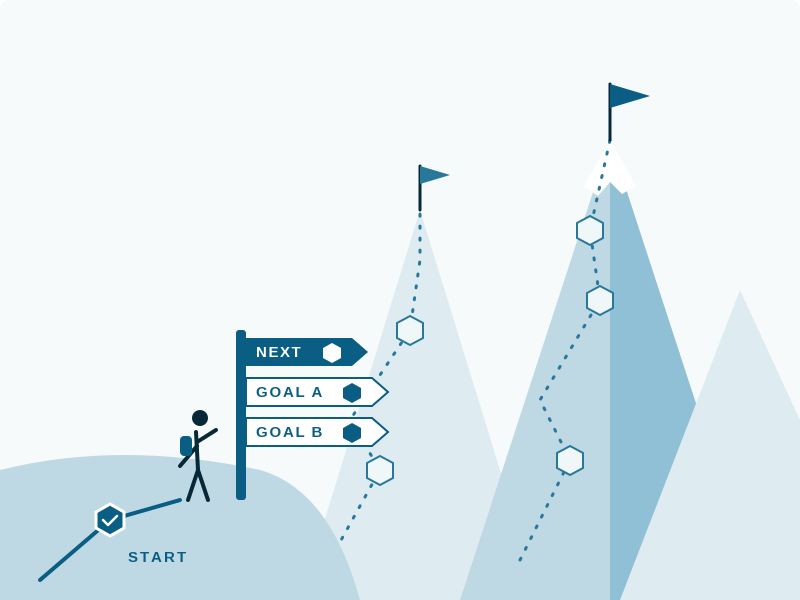
Until now, deciding what to learn next has depended only on a person's own intuition or on advice from people around them. Even after completing a course or earning a qualification, people cannot clearly see how it connects to the job they are aiming for. Learning has kept accumulating, yet the path ahead has remained unclear.
As Open Badges spread, that path comes into view. "What badges do people who excel in this job hold?" "What badges does the role you are aiming for require?" As each person's badges connect, the combination of learning required for each job and role emerges. By tracing the badges of people close to who you want to become, you can see what you are missing now, in terms of specific badge names.
What you learn becomes another badge and leads to the next signpost. Learning is not a one-time destination but a path that continues to the next goal. In the future, systems in which AI suggests the next learning or badges suited to each person's goals, based on collected badge data, will likely become more widespread. Open Pathways is an approach that makes that path visible to both learners and issuing organizations.
The Open Pathways approach
Decide who you want to become
Picture the job or role you are aiming for, or the people you want to be like.
Find the badges you need
Check the badges held by people close to that goal and the badges that are required. In the future, AI recommendations will also serve as a guide.
Choose what you still need to learn
Compare with the badges you have now and decide what to learn next.
Earn badges and move on
What you learn becomes a badge, and the next signpost comes into view.
01Work backward from who you want to become
The combinations of badges held by people you want to be like, or by people in the job you are aiming for, become your own learning map. You can think about your vague "next step" in terms of specific badge names.
 02
Learning connects across organizations
Because Open Badges follow a global standard, badges from different organizations, such as university classes, corporate training, and certifications from certification and examination bodies, can be connected into a single pathway.
 03
Issuing organizations can suggest what to learn next
By showing where their badges sit within pathways toward specific roles and skills, issuing organizations can guide participants to their next courses or higher-level certifications.
Use Cases
Use cases for Open Badges
See how Open Badges are used in each setting.
01TRAINING
Corporate training and talent development
Companies can turn the results of training, in-house certifications, and reskilling into badges and use them to motivate employees to learn and to develop talent.
02HIGHER EDUCATION
Use in higher education
Universities can issue learning such as course completion, study abroad, and awards in small units as digital credentials that follow a global standard.
03RECRUITMENT
Recruitment and proof of skills
With credentials that make tampering detectable, applicants can show what they can do in the hiring process, which academic and work history alone cannot reveal.
04OPEN PATHWAYS
Open Pathways
Issuing organizations can work backward from a learner's goal, present the badges needed as a pathway, and guide learners to what to learn next.
FAQ
Frequently asked questions about Open Badges
A summary of common questions for organizations considering issuing badges.
How are Open Badges different from digital badges and PDF certificates?
The term "digital badge" refers broadly to digital insignia that show learning or achievements as images, including badges that are only images. Among these, Open Badges are the ones that follow the Open Badges global standard, carry information such as the issuer and criteria, and let anyone the badge is shared with check their content. Unlike credentials that are only an image or a PDF, they also contain information such as the date earned. For issuing organizations, this means criteria and outcomes can be recorded and delivered as they are.
How do Open Badges relate to microcredentials?
Microcredentials are a concept for certifying small units of learning, such as short courses or one-time training sessions. Open Badges are one of the global standards for issuing and sharing them. They can also serve as material for showing the pathway to the next learning (Open Pathways).
Who creates and manages the Open Badges standard?
The standard is managed by 1EdTech, an international organization that develops technical standards for education. Open Badges grew out of a project announced by Mozilla in 2011 and financially supported by the MacArthur Foundation. Since 2017, IMS Global Learning Consortium has managed the standard, and in 2022 the organization changed its name to 1EdTech. Open Badges 3.0 was published as a final version in May 2024, and revisions have continued since then.
How are Open Badges verified as authentic?
Open Badges 3.0 uses a format that follows Verifiable Credentials (VC) of W3C (an international organization that sets web standards), as defined in Verifiable Credentials Data Model 2.0 (the 1.1 format is also accepted). The issuer's digital signature makes it possible to confirm that the issuer is genuine and that the badge has not been tampered with. Because verification can be done online, issuing organizations can reduce the work of responding to inquiries about content and reissuing badges.
Can organizations in countries and regions outside Japan ask for a consultation?
Yes. Organizations in countries and regions outside Japan can also ask for a consultation. APON is an organization that connects initiatives across the Asia Pacific region. For a consultation on adopting or issuing Open Badges, please get in touch through the Contact page.
Contact
Consultations on issuing badges are accepted by email
Please feel free to get in touch about issuing badges, collaboration, events, media inquiries, and more.